
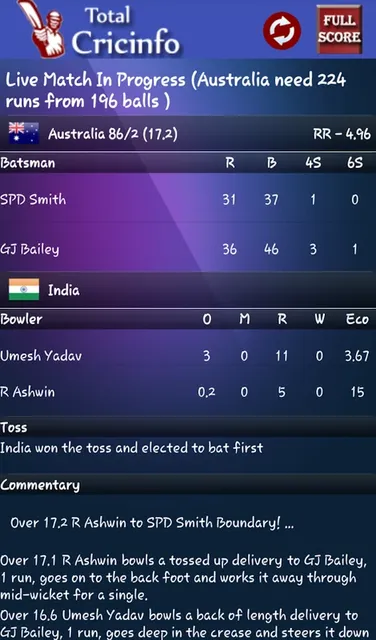
In cricket, the bowling economy is a crucial statistic that measures a bowler's effectiveness. It's calculated by dividing the total runs conceded by the bowler by the number of overs bowled. This article will guide you through the process of calculating bowling economy and provide insights into its importance in cricket analysis.
Direct Answer
To calculate the bowling economy rate, you need to know two key pieces of information: the total runs conceded by the bowler and the number of overs bowled. The formula for bowling economy is:
Bowling Economy = Total Runs Conceded / Number of Overs Bowled
For example, if a bowler concedes 30 runs in 6 overs, the bowling economy would be 30 / 6 = 5.00.
Detailed Explanation
The bowling economy is a measure of how many runs a bowler gives away per over. It's an important statistic for evaluating a bowler's performance, especially in limited-overs formats like T20 and ODI cricket. A lower economy rate indicates better bowling performance.
The calculation is straightforward but requires accurate record-keeping during a match. Bowlers are often evaluated based on their economy rate, alongside other metrics such as wickets taken and overs bowled.
Key Features / Steps
Here are the steps to calculate bowling economy:
- Step 1: Keep track of the total runs conceded by the bowler during the match.
- Step 2: Count the number of overs bowled by the bowler.
- Step 3: Use the formula: Bowling Economy = Total Runs Conceded / Number of Overs Bowled.
- Step 4: Round off the result to two decimal places for the final economy rate.
For instance, if a bowler concedes 45 runs in 9 overs, the calculation would be 45 / 9 = 5.00.
Common Misconceptions or Pro Tips
One common misconception is that a lower bowling economy always indicates better bowling performance. While generally true, other factors like wickets taken and the context of the match also play significant roles. For example, a bowler who takes crucial wickets but gives away a few extra runs might be more valuable than a bowler with a lower economy but fewer wickets.
Another tip is to consider the overall match situation. In high-scoring matches, a slightly higher economy rate might be acceptable if the bowler restricts the opposition to fewer boundaries and wickets.
Conclusion & CTA
Understanding how to calculate bowling economy is vital for cricket enthusiasts and players. This statistic provides a clear indication of a bowler's effectiveness in restricting runs. Whether you're playing in a casual match or a professional tournament, mastering this skill will enhance your performance analysis and strategy.
For more cricket insights, tips, and live streaming, visit cricify.
 How to Calculate Bowling Economy in Cricket